

Mountain Bike: Top 3 Tips
We’ve teamed up with the guys over at Singletracks.com so that we can start brining our readers more articles on Mountain Biking. We try to cater to all types of riders of all levels and abilities here at Loving the Bike, but seeing as I’m primarily a road cyclist the focus tends to shift mostly in that direction.

Starting right now, we’ll be posting mountain bike articles each month courtesy of Greg Heil and Singletracks. They definitely know their stuff when it comes to mountain biking, and we’re so happy to connect with them.
Top 3 Mountain Biking Tips
by Greg Heil
The relation of mountain biking to road biking/cycling fascinates me. On one hand, they each seem to be just a different side to the same biking coin. But on the other hand, mountain biking is oftentimes so radically specialized when compared to road biking that it seems like a different sport entirely.
Since these sports are so different, transitioning from the road to the trail can be a daunting task. Specifically, while road riders often bring an amazing fitness base to the mountain bike trail, the technical side of the sport usually proves to be challenging. While I could write for days about mountain bike skills, here are the three most basic mountain biking techniques that you should have in your arsenal:
1. Look where you want to go
When they first start mountain biking, many beginners have the tendency to look down at their front wheel in an attempt to see where it is going, or they focus their on obstacles in the trail. These tendencies are detrimental to good mountain biking. When riding singletrack, it is imperative that you look where you want to go.
For instance, is there a tree that you want to avoid? OK, well notice that tree, and then look down the trail and past it to where you want to end up. If you stare at the tree the entire time, you will run smack-dab into it. Are you riding along a steep cliff? While it’s tempting to stare off into the distance and enjoy the view, if you do without coming to a stop first, your front end will probably plummet straight off the edge.
While I’ve attended a skills clinic that spent literally an entire day discussing and practicing good vision, the simple truth is that you need to look down the trail. Focus on where you want to go. And the faster you’re going, the further down the trail you need to look.
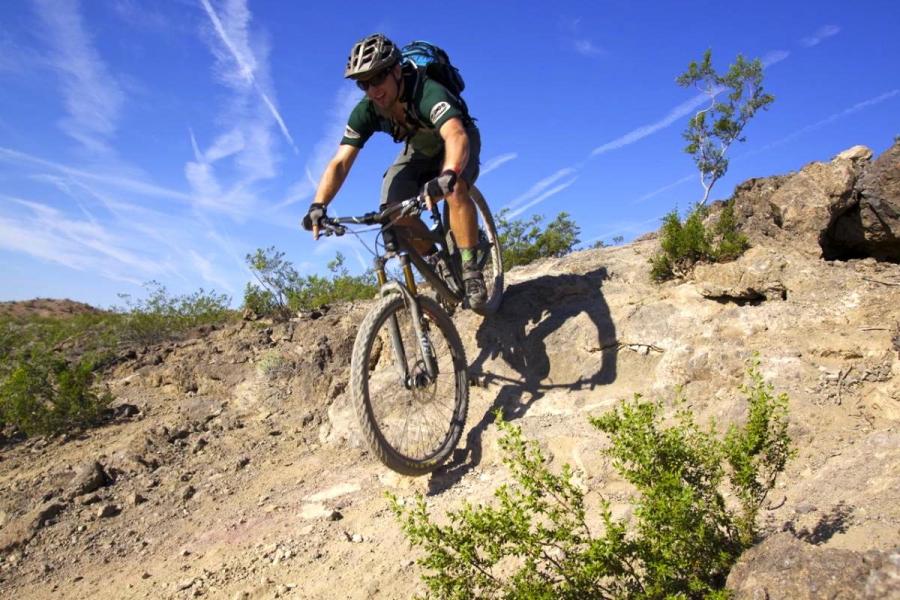
All three of these tips melding together seamlessly in one photo. Rider: Greg Heil. Photo: Jeff Barber.
2. Brake smart
Many times when I’m riding with beginners, I’ll see them get up too much speed and lose control, careening off the trail until the underbrush finally stops their forward progress. When I ask them what went wrong, the conversation usually goes like this:
“I couldn’t stop.”
“Were you using your brakes?”
“Of course.”
“Were you using both of your brakes, your front brake, or your rear brake?”
“Just my rear brake.”
“Why weren’t you using the front brake?”
“I’m afraid of flipping over.”
Since your weight is driving down the hill with the force of gravity and the momentum that you’ve gained, about 70% of your total braking power is contained in your front brake, with only about 30% of your total power in your rear brake. If you use just the rear brake, you are only using a fraction of the total braking power available to you.
Obviously, locking up the front brake is a bad idea: there is a reason many people are afraid of using the lever on the left handlebar. To keep from flipping over, it’s important to use both of the brakes together. Not only does use of the rear brake help mitigate some of the potentially harsh effects of the front, but you now have 100% power instead of just 30%.
Finally, when you brake, do not lock the brakes up. Avoiding locking the brakes will eliminate the fear of doing an “endo,” but that is not the primary reason to avoid it. If you lock the brakes up, the bike begins to skid and go out of control. In order to slow forward progress as quickly as possible, the tires need to maintain solid contact with the ground. This is the same idea behind anti-lock brakes on cars.
3. Let the bike flow beneath you: calm upper body
Suspension is an extraordinary thing, and it can really smooth out the trail and provide forgiveness when your skills don’t measure up to the challenges that the trail provides. However, no matter how much suspension your bike has, your arms and your legs have more—your body is your primary suspension.
In order to soak up bumps from rocks, roots, and other trail obstacles, it is important to let the bike move under you. If you can allow the bike to buck beneath you and jolt without having those jolts throw your body all over the place, you will ride with much more control. Some people ride so rigidly that every little thing jolts them off balance, but if you can learn to separate your body from the bike it will make for a much smoother ride.
Your Turn: What questions do you have about mountain biking technique?
Greg Heil started riding mountain bikes seriously in 2007, and since that time has ridden hundreds of trails all across the United States. He is the Social Media Coordinator and an editor for Singletracks.com, which is your source for everything mountain biking: the number one mountain bike trail map database in the world, a daily blog, gear reviews, forums, photo of the day, and more! Be sure to drop by the site and check it out, and “follow” them on Twitter.


Useful tips for beginners. Thanks
You’re welcome, David.
Major thanks for the blog article. Cool.
You’ve pointed some important things which are really helpful for the beginner cyclist. It would be better if you add more tips for bike maintenance. Thanks
Hi Zachary, we do have several articles on bike maintenance and you can find them at https://lovingthebike.com/?s=maintenance. If there are any specific questions you have, just let us know.
Wow these tips look very helpful for me! I have started mountain biking a year ago and I am learning a lot about mountain biking from different types of blogs. I really appreciate your tips.
John Reese
Founder at: http://www.bestbikepicks.com/
While we can’t exhaust all options for leads, I will only concentrate around the most
beneficial in the following paragraphs:1) People in legal trouble.
It competed using the New York Stock Exchange and Nasdaq’s in the worlds.
While angel investors are likely to be forced to invest no
less than R 300 000 in funds annually, the idea could be
that the network’s individuals collectively invest to get businesses going and in the end generate income by selling their holdings within 3-5
years.
This tips is really helpful. But I expected more tips. Hope I get lots of tips when i return this blog.
Dear Good Evening,
Just thought I would drop you a quick mail regarding your website lovingthebike.com I really enjoy
the stuff you write, and it has been getting me excited.
I have been running a blog on Cool Ideal Bike, and writing my experience and product reviews. I
really love writing on this topic. As the topic of your blog and mine is similar, I would like
to contribute to your blog with a blog post (or several if you like me to continue writing).
If you give me permission, I can start writing for your blog post. I’ve some topic in mind, or
if you suggest me some topic, which will well suit your reader, that’s even more awesome!
I’ll wait for your valuable response.
Thanks in advance,
Larry Saize
https://coolidealbike.com
Woah! I’m really enjoying the template/theme of this site.
It’s simple, yet effective. A lot of times it’s tough to get that “perfect balance” between superb usability and visual appeal.
I must say you’ve done a awesome job with this.
Also, the blog loads extremely quick for me on Chrome. Exceptional Blog!
Hey just wanted to give you a quick heads up and let you
know a few of the images aren’t loading properly. I’m not sure why but I
think its a linking issue. I’ve tried it in two different web browsers and both show the same outcome.
This site really has all the info I wanted about
this subject and didn’t know who to ask.
Why users still make use of to read news papers when in this technological globe the whole thing is accessible on web?
My brother suggested I may like this website. He used to be totally right.
This put up truly made my day. You cann’t consider simply how so
much time I had spent for this info! Thank you!
Thanks for sharing your thoughts aboutt Mountain Bike. Regards
Just wish to say your article is as astounding. The clearness in your
post is just nice and i can assume you are an expert on this subject.
Fine with your permission allow me to grab your feed to keep updated with forthcoming post.
Thanks a million and please carry on the rewarding work.
Chartered a ride in the spring, and I overheard my guide telling the roadies that were off on their first MTB trip ever with us, in Vegas’s Blue Diamond trails…”your front wheel can only do one thing at a time…you can use the front brakes to stop, or the front wheel to turn, but both at the same time is not a recipe for success”. His advice rings in my ear when I’m in a hairy braking/steering situation to this day. The roadies, who were bragging on their 40-60 mile days on the road bike, were beat after 11 miles in the desert. They were, by far better athletes than I, but I killed it this day, with a hangover. They really did not care at all for the movement of the bike and the feeling of lack of traction or sliding. I pulled the Nascar/F1 analogy…ones not better than the other, its just different. Both are race cars that go really fast, they just have different equipment, fans, drivers and courses. Same thing
Although I am by no means an advanced rider, I’ve been enjoying my mountain bike for years in Crested Butte. I’d never been on a road bike and recently bought one to expand my bike-loving experience. I find differences between the two almost daunting. The road bike is instantly responsive, spare and clean…but it often scares me. I can’t even look over my shoulder without skittering all over the place. Are there tricks to transitioning back and forth between the two bikes?
@Denis, I am by no means an experienced road rider. I’m actually looking to buy a road bike right now, and have ridden road maybe a half dozen times or more. But I have to say that I actually have no issues just hopping on a road bike and going. I actually just rode a road bike yesterday that I had never been on before, and again I’ve only ridden a road bike maybe a half dozen times in my entire life, but it felt very natural and was just a lot of fun! Perhaps there’s an issue with the cockpit setup on the road bike? You don’t have to have the lowest, most aggressive style out there–you could maybe adjust it be a little more upright, but I’ve generally found that I have the most control at speed when in the drops. Also, I’ve only used my mountain shoes and pedals and the rest of my mountain kit when on the road bike. Not sure if using road shoes and pedals would make the transition more difficult or not.
Other than that, I can’t really say due to my lack of experience as a road biker. Maybe others can chime in?
Denis, totally with you on this one. I was pretty intensive MTB rider for about 15 years before I got my first road bike. I had the exact same experience. The road bike felt fast, but weird, flimsy and very unstable. I feared a gust of wind would throw me over. It sounds obvious but you get more comfortable over time, don’t be put off by it just go for some rides on well paved low traffic roads and just get a feel the for the bike. Practice braking, it’s quite different without the discs. Try sprinting, spinning slowly and leaning in the corners. The more you test it out the more you’ll realize what the bike is capable off and you’ll get more comfortable.
Singletracks makes a good point below, don’t ride a road bike that’s too aggressive with the riding position, more upright seating is better to get used to it. You can always adjust later as you get more comfortable. And either use your mountain bike clips as you’re used to them already as Singletrack suggests, or do what i did and just ride with toe straps till you get comfortable on the road bike. Then switch to clips.
A good way to get used to your front brake is to disconnect the back one. This will force you to learn the front and use it more often..
Yes and no, as the best way to break is to use both brakes together. If you learn how both brakes complement each other, then you’re golden!
I have a question. I have been mtbking with my husband for 5 yrs. now. I can say I am a lot better now with those basic tips. I am a better climber and I am braver with tackling downhills (steep ones). My only problem (& my husband’s problem too) is I cannot start up again once I stop on an uphill. My husband has been teaching me all these years (can you imagine his frustration and MY frustration) on how to do it. My fear is that I will fall on one side (my left side because I clip in on the right foot). I put it in a bigger gear but still I don’t feel safe doing it. So what my husband does is he holds my seat to keep me and my bike upright and I sit down on the seat. I pedal and then he gives me a push (of course, he rolls his eyes first before he does all these). I tried looking for videos on how to do it but I only found one (and it was not very helpful). Any tip will help. I feel that if I can do this “trick” it will make our mt biking rides more enjoyable and with “less drama.”
Thanks!!!
Start by moving your bike to a clean line. If you clip your right foot 1st, place that pedal at the top of the stroke. It is important that you create some momentum with that first pedal stroke, that being said you will want your weight to be over the rear of the bike and try to push down smooothly. This will prevent you from spinning the rear tire. Work on your bike balance. When coming to stop, clip out but don’t take your feet of the pedals. See how long you can stay up w/o putting a foot down. This will help you stay upright when getting started as well.
+1
For a cheap solution, you could try riding with flats for a while and specifically work on starting in the middle of an uphill section. You should be able to find cheap, BMX-style pedals at your LBS if a pair did not come with your bike. Use them for a month or so and once you know you can start in the middle of an uphill section you can go back to clipless.
Another, more expensive, option would be using different clipless pedals that have a large cage to them. I use the Shimano PD-M545. I would stay unclipped until I felt comfortable enough to clip back in when going uphill. Crank Brothers Mallets are another option if you like the egg beater style cleat.
Yeah flats might make it easier, but I think the basic problem here is technique, not equipment.
Hey,
thanks for the question! Not quite sure what you mean by a bigger gear,
but if you’re starting on a hill you probably want to be in as easy of a
gear as possible. If you fell on a steep or rocky section, it’s
probably best to push to a spot in the trail where it flattens a bit.
From there, start by clipping in whatever foot is downhill. If the drop off on the trail is to the left, clip in your left foot–do not clip in your right foot first. If you cannot clip in first with your left foot, practice clipping in and out with both feet at home in a grassy yard or field. Use your uphill foot to steady yourself on the uphill side of the trail. Push down from the top of your pedal stroke with your downhill foot, and as the other pedal comes around, get your uphill foot on it and apply smooth, even pressure. It is important, and more important the steeper the hill is, to get immediate power as the other pedal comes around (not alot, just enough). Don’t worry about clipping in your second foot yet (unless you’re very confident)–just worry about getting power going. Once you’re under way, you can make sure you’re clipped in to your satisfaction.
If the trail is very steep, you can start with your bike sort of angled across the hill, with your back wheel off the trail a bit and your front wheel on the trail to lessen the initial angle as you begin. This technique is kind of difficult to explain without showing… maybe a topic for a video blog? But for about 90% of my remounts, the above paragraph works great.
Finally, if you live in a place with a lot of trees, you can always grab a handy tree, hop on the bike, steady yourself, clip in, and start again. That makes it dead easy 🙂
You are so right about braking smart. That is good advice and I sort of learned it the hard way. I’d like more tips for intermediate riders so keep them coming.
Will do!
Thanks for the tips. I’m still pretty new to mountain biking but really want to get more comfortable out there. I just took a look at singletracks website and it looks like more great information over there.
Thanks man! Yeah we have just about anything you need 😉 if you have a question you can always post on the forums. We have a lot of great members who are willing to help!
Great tips for beginners! However, as to tip #1 I would add that its easier said than done. I think plenty of very experienced mtn. bikers (myself included) are still working at that. Tip #2 is SO TRUE, for a long time I was under the same assumption that the front brake will make me endo. I had to reprogram my braking instincts which is very difficult and now only use the rear brake sparringly when I have to. Also, one tip I try to give, which I learned the hard way is don’t brake while ON any technical rocks or limbs, you’re sure to endo or crash. If you have to brake, brake before and let the momentum carry you over. My mantra is “Momentum is Your Friend” since I’ve learned countless times that its when I brake or do something else to try to avoid or control a technical situation is when I get hurt. Instead, relax, and let the bike do what it’s designed to do and let your momentum carry you over the scary stuff.
Yes, it is definitely easier said than done, but it is hands-down the most important skill that you can master as a mountain biker. But like you said, it’s not easy. I attended a 3-day MTB skills course this spring, and an entire day was spent talking about and practicing vision. And then in days 2 and 3, since it is such a fundamental skill, we kept on practicing and practicing 😉 http://www.singletracks.com/blog/mtb-training/betterride-core-skills-1-camp-why-everyone-should-take-mtbing-lessons/ More on vision here: http://www.singletracks.com/blog/mtb-training/transitioning-ski-board-skills-to-the-mtb-trail/
I gave my kids “rules” when we started mountain biking…a little different than your rules. My rules were 1) you will crash, 2) you will hurt, 3) you will not cry, whine, or refuse to ride after a crash unless you need medical attention. I said it to be funny so they wouldn’t feel bad about falling, but it worked. Now they tell their friends these rules when we bring them along.
Haha awesome!
When the days get shorter and the temps start dropping thats when I pull my mountain bike out and hit the trails. It’s a nice break from the road.
+1! My next blog topic 😉
I just bought a mountain bike last month and am going to keep riding it until it gets colder. Thanks for the tips these are great.
No problem, glad you enjoyed them!
It sure is awesome to see Singletracks dot com going beyond their website…
Glad you think so, blundar! It’s fun to network with great people like Darryl!